

























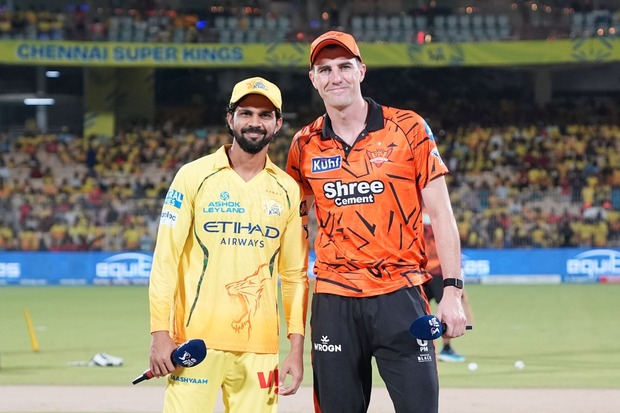
There are failures in T20 cricket that happen because conditions are difficult, bowling is exceptional, or pressure becomes overwhelming. And then there are failures born out of hesitation. Chennai Super Kings’ defeat to Sunrisers Hyderabad on Monday night felt very much like the latter.
Midway through the 10th over, when Kartik Sharma uppercut Pat Cummins straight to the sweeper cover fielder, CSK’s captain Ruturaj Gaikwad was crawling on 15 off 19 balls. Around him, wickets had fallen – but at least those dismissals came in pursuit of momentum.
Sanju Samson had begun brightly, smashing 27 off 13 before falling to Cummins. Urvil Patel briefly threatened SRH with two sixes in three balls before throwing his wicket away trying another big shot. Kartik too attempted to force the pace. None of them succeeded for long, but they at least acknowledged the demands of modern T20 cricket.
Gaikwad, however, seemed to be playing a completely different format.
The pitch was not easy. Slower balls gripped, change-ups held in the surface, and the slow bouncer proved awkward throughout the innings. Even CSK coach Stephen Fleming reportedly believed 175 was a competitive total on the surface. But difficult conditions do not excuse complete inertia; especially in a format where intent matters almost as much as execution.
Until the ball that finally dismissed him, Gaikwad never truly attempted to impose himself on the bowling. He did not try to manufacture pressure release. He did not rotate aggressively. He did not take calculated aerial risks. He simply drifted.
There is, of course, a place in T20 cricket for an anchor — particularly in weaker batting units where one player stabilises the innings while others attack around him. But anchors still need to move the game forward. Gaikwad’s innings did the opposite. By the time he eventually fell for a painfully slow 15 off 21 deliveries, CSK had already lost control of the contest.

And fittingly, it was Cummins who removed him.
The dismissal perfectly captured the difference between the two captains. Cummins identified a struggling batter, stationed protection in the deep, banged the ball in short, and forced the mistake. It was proactive, intelligent captaincy — the kind that constantly manipulates situations rather than merely reacting to them.
That is what separates elite T20 leaders from passive ones.
Cummins has become the heartbeat of this SRH side. Whether through tactical bowling changes, personal performances, or sheer game awareness, he remains relentlessly involved. His wickets of Samson, Kartik and Gaikwad decisively tilted this game SRH’s way, further cementing his status as one of the IPL’s most influential captains.
CSK’s season, meanwhile, hangs by a thread with uncomfortable questions. Chief among them: can a side realistically compete in modern T20 cricket when its captain becomes a liability rather than a driving force?
Against SRH, the answer felt brutally obvious.