


























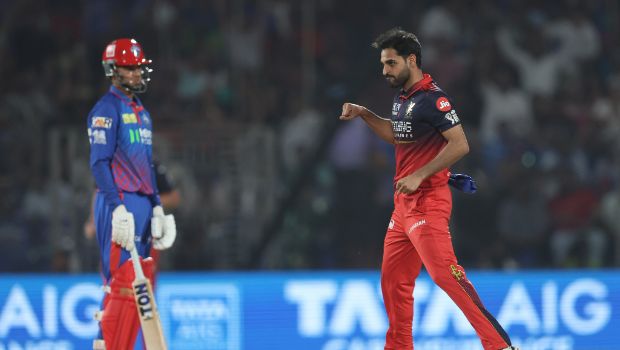
Delhi Capitals’ dramatic collapse on Monday night at the Arun Jaitley Stadium served as a stark reminder of T20 cricket’s wild unpredictability. Just two days after posting a staggering 264 on an adjacent pitch – and still ending up on the losing side – Delhi produced an innings that defied belief, crumbling to 75 all out in 16.3 overs. The contrast between the two performances was not just striking; it was almost surreal.
This, despite being a T20 game, had the unmistakable feel of a Test match in England. The ball swung late, seamed just enough, and made life extraordinarily difficult for the batters. But even allowing for helpful conditions, what unfolded was difficult to comprehend. Thirteen balls into their innings, DC were already four wickets down. By the end of the powerplay, they had slumped to the lowest six-over total in IPL history.
At the heart of the early damage were Bhuvneshwar Kumar and Josh Hazlewood, who bowled with precision, discipline, and just enough menace to dismantle Delhi’s top order. Both claimed three wickets inside the powerplay, exploiting conditions that were clearly in the bowlers’ favour. Which makes the decision at the toss by Rajat Patidar to bowl first look entirely justified.
However, Delhi’s troubles were not just about conditions or quality bowling. There were questionable decisions too. KL Rahul, who had scored a sublime 152 at this very ground just two days earlier, chose to take strike at the start. In doing so, he exposed debutant Sahil Parakh to Bhuvneshwar in helpful conditions—an odd call given Rahul’s experience. Parakh was yorked second ball, setting the tone for what was to follow.
Hazlewood then took over, striking with his first two deliveries. Rahul himself was hurried by a sharp short ball that climbed onto him, forcing a pull that was safely taken by wicketkeeper Jitesh Sharma. The very next delivery saw Sameer Rizvi chasing width and edging behind. In his next over, Hazlewood produced a snorter to bounce out Nitish Rana.

Meanwhile, Bhuvneshwar continued to probe relentlessly, drawing edges from Axar Patel and Tristan Stubbs as DC collapsed to an astonishing 8/6. At that point, the lowest IPL total ever- 49 by RCB against Kolkata Knight Riders in 2017 – looked under serious threat.
Some resistance did come. Abhishek Porel scored 30 and David Miller added 19, helping Delhi limp to 75. Hazlewood returned to clean up Porel with a yorker, finishing with outstanding figures of 4/12 in 3.3 overs, while Bhuvneshwar ended with 3/5 from three overs.
Chasing a modest target of 76, RCB made light work of the total, sealing victory in just 6.3 overs. Virat Kohli remained unbeaten on 23, and in the process became the first player to cross 9000 runs in IPL history. Devdutt Padikkal provided the fireworks, smashing 34 off just 13 balls to wrap up a comprehensive win.
For Delhi, this was more than just a defeat – it was a collapse that will demand serious reflection.