

























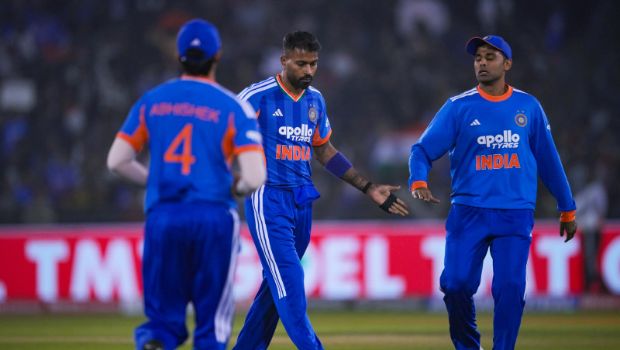
India enter the 2026 T20 World Cup as one of the strongest teams in the tournament, both on paper and in recent performances. The squad combines experience, depth, and versatility across departments, making Team India genuine title contenders once again. Yet, as has often been the case in recent ICC events, the real challenge may not be about skill or balance, but about execution in the biggest moments.
Suryakumar Yadav’s team’s biggest strength lies in their fearless approach, batting depth and flexibility. This is a side that can realistically bat till No. 8, allowing the top order to play aggressively without the constant fear of collapse. The Powerplay has become a phase of intent rather than caution, while the middle overs — traditionally a problem area — now feature players capable of maintaining tempo rather than merely consolidating.
What makes this batting unit particularly dangerous is adaptability. India can go hard from ball one on flat surfaces, but they also have the personnel to absorb pressure and rebuild if early wickets fall. Sample the recent T20Is against New Zealand, where in game one it was Abhishek Sharma who attacked despite three early wickets, or the next match in which Ishan Kishan slammed 76 from 32 balls after the score was 6/2 early on. Finishers such as Hardik Pandya, Rinku Singh and Shivam Dube, with proven boundary-hitting ability, ensure that totals can be stretched well beyond par, even after not so brisk starts.
With the ball, India arguably possess the most well-rounded attack in the competition. They have genuine wicket-taking options in the Powerplay, elite control at the death, and multiple spin combinations to suit different surfaces. The presence of fast bowlers who can operate across phases, supported by spinners who attack rather than contain, gives the team tactical flexibility rarely matched by other sides.
Despite the depth, India are not without vulnerabilities. A recurring issue remains their dependence on the top three batters for momentum. When early wickets fall, the scoring rate has at times dipped sharply before the finishers arrive. In high-pressure knockout matches, those quiet overs can prove costly.
There is also the intangible but significant factor of knockout pressure. India’s record in group stages of global tournaments is consistently strong. It is the semi-finals and final where clarity of decision-making and freedom of expression have occasionally deserted them. Overcoming this mental barrier may be the single biggest determinant of how far they go.
Several key players arrive at the World Cup in encouraging form. The captain, Surya, has rediscovered his scoring touch, bringing back the fearless 360-degree batting that sets him apart. Pandya looks fully fit, contributing both as a finisher and as a seam-bowling option, which significantly improves team balance.

In the bowling department, Jasprit Bumrah and Varun Chakravarthy remain India’s biggest match-winners. Bumrah’s ability to control games in both the powerplay and death overs is unmatched. Alongside him, Varun is a crucial middle-overs wicket-taker, particularly effective against line-ups heavy on right-hand batters. And he can also be called on to bowl the fifth or sixth overs.
But not everyone is peaking at the same time. Sanju Samson, glaringly, is woefully out of form, and 46 runs in five matches pales in front of the 215 that his competitor, Ishan Kishan, smashed in four innings at a strike-rate of 231. Kuldeep Yadav, a match-winner on most days, has been a bit off in recent ODI and T20I appearances, and Harshit Rana too is coming off a tough series against the Black Caps.
In a short tournament, even one or two low-impact games can put pressure on team combinations and selection calls.
India’s chances of lifting the trophy are strong. Realistically, they rank among the top two teams in the competition. If they continue to play their brand of fearless cricket, make proactive tactical decisions, and avoid conservative instincts in the knockouts, this is a World Cup they are fully capable of winning.
Ultimately, the difference between India being finalists or champions will not just be talent. It will be mindset.