























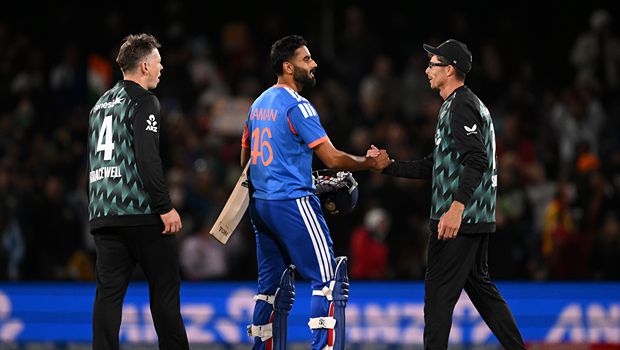
The first game of the India vs New Zealand T20I series was a brilliant contest, with visitors producing an excellent run chase. I expect the second T20I at the same venue to be a similarly competitive affair, although I hope there will be a little more assistance for the quicker bowlers on the surface this time around.
Having played at Hagley Oval and commentated on a number of games there, I have always felt that there is something in the conditions for the fast bowlers. Whether that comes into play in the second match remains to be seen, but I would certainly like to see the bowlers have a little more influence on the contest.
The dew factor, meanwhile, is likely to remain a significant talking point. It had a major impact on how the first game was played, and I suspect it will once again influence the approach of both teams. I have always found it a little disappointing when dew makes such a difference because it places so much importance on the toss. Both sides will want to chase in the second innings, knowing that batting could become easier as the game progresses.
That puts an enormous amount of pressure on the team batting first. It is not simply about putting a competitive total on the board; it is about getting yourself into a sufficiently strong position to remain ahead of the game when the dew arrives. That is a difficult balance to strike, and I expect the toss to be just as crucial in the second T20I.
India could bring in Sooryavanshi
As far as India’s team combination is concerned, I expect Vaibhav Sooryavanshi to come into the side if Ishan Kishan is ruled out because of injury. I also believe India could make a few adjustments to their batting order to accommodate that change.
I would expect Sooryavanshi to open the innings, with Sanju Samson moving to number three, Shreyas Iyer at four and Tilak Varma returning to number five. I am not a massive fan of Tilak batting at number three, although I appreciate that the decision in the previous game could have been influenced by injury-related circumstances. I much prefer him at five, and I think that is where he is likely to bat if India make the changes I anticipate.
Samson, in particular, deserves considerable credit for the way he has handled the pressure surrounding his position in the team. There has been plenty of media and social media speculation about his place, but he has responded extremely well. He must be aware of the scrutiny, yet he has continued to play his game and deliver performances.
That is not always easy when there is so much discussion about your position, and I think the way he has responded speaks highly of him. If he moves to number three, it could also help India settle into a more familiar batting order.
There is another interesting tactical aspect to consider if India have two left-handers opening the innings. New Zealand could look to bring Michael Bracewell into the attack a little earlier, while Glenn Phillips could also be an option with his off-spin during the opening overs. It will be interesting to see whether New Zealand make that adjustment and whether it changes the way the first few overs unfold.
India’s bowling balance needs attention
One area where I would like India to think carefully is their bowling combination. I have never been entirely comfortable with India playing four
seamers. I understand that all four might not necessarily bowl their full allocation in every game, but I generally feel that India are better served by having an additional spin option.
The question, for me, is where Nitish Kumar Reddy fits into that combination. Is he going to be India’s third seamer, or are they comfortable with him operating as the fourth seam-bowling option? That is an important distinction because it determines how much flexibility India have elsewhere in the attack.
Naman Dhir was excellent with the bat in the first game, but India did not need to use him with the ball. That is another consideration when looking at the overall balance of the side. I would still lean towards having an extra spinner, although the final decision will depend to some extent on the conditions.
I would also like to see Bhuvneshwar Kumar get another opportunity. I am pleased that he is playing, and I think the conditions in Christchurch and New Zealand should suit his style of bowling. He is the kind of bowler who can exploit the conditions well, and I hope he gets the chance to make an impact in the second game. He would certainly want a better outing after the first match.
India will have to assess all these factors before settling on their final combination. There is no need to make wholesale changes, but I do think the balance of the side is worth considering, particularly if the conditions offer the seamers a little more assistance. I feel India’s bowling unit will feel under a bit of pressure.
New Zealand should consider promoting Glenn Phillips

For New Zealand, Daryl Mitchell remains a hugely important player, particularly in one-day cricket. He is a fantastic ODI batter and has caused India plenty of problems over the years. However, I am not convinced that batting at number three is necessarily the best role for him in T20 cricket.
I think New Zealand need to look at that position and consider whether Glenn Phillips would be better suited to batting higher up the order.
I have been a huge fan of Phillips for a long time. I have always felt that he should play more IPL cricket and be given greater responsibility in the batting order. He is a brilliant fielder, a dynamic batter and a very fine all-round cricketer who can contribute in different phases of the game.
His performance in the first match only reinforced my view that he should bat at number three. I think he has the ability to make a substantial impact in that position, and promoting him could give New Zealand a particularly dangerous top order.
With Finn Allen and Tim Seifert also providing considerable power, New Zealand have the ingredients to put pressure on any opposition. Comparing their top three directly with India’s is not straightforward, but I do not think the difference is particularly significant in terms of the firepower available. New Zealand have plenty of attacking potential, and their top order can cause India serious problems if it gets going.
Santner’s fitness could be crucial
Another major consideration for New Zealand is the fitness of Mitchell Santner. We will have to wait and see how he recovers, but his availability could be extremely important for the side.
Santner is not just a significant figure with the ball; he is also becoming a very astute leader. He understands how to use his bowling intelligently, and
his experience and influence make him an important part of the team. I hope, for New Zealand’s sake, that he recovers sufficiently to take his place in the second game.
I also like the battery of fast bowlers New Zealand have at their disposal. Adam Milne, Lockie Ferguson and Matt Henry were not quite at their best in the opening match, but I like the balance that combination offers. With Bracewell and Phillips providing additional bowling options, New Zealand have different routes they can take depending on how the game develops.
That flexibility could be useful, particularly if the conditions offer the fast bowlers more assistance than they had in the first match.
Kyle Jamieson is another viable option if New Zealand feel they need to make a change to their bowling attack. I have always felt that he brings value to New Zealand sides with both bat and ball.
I hope the bowlers have more of a say
Overall, I expect the second T20I to be very similar to the first: competitive, high-scoring and closely fought. India have shown that they can chase down a substantial target, while New Zealand have enough firepower to put them under pressure again.
My one hope is that the bowlers have a little more influence this time around. Scores of 230, 240 or 250 make for entertaining cricket, and there is no denying that such matches can be exciting to watch. But I also enjoy contests in which bowlers have something to work with and can make a genuine difference.
If the conditions offer them a little more assistance, we could see a different kind of contest without losing any of the excitement of the opening game.
India and New Zealand have enough quality to produce another excellent match. I expect it to be very competitive, and hopefully the bowlers will have a greater say in deciding the outcome this time around. Let’s hope for a good contest.