


























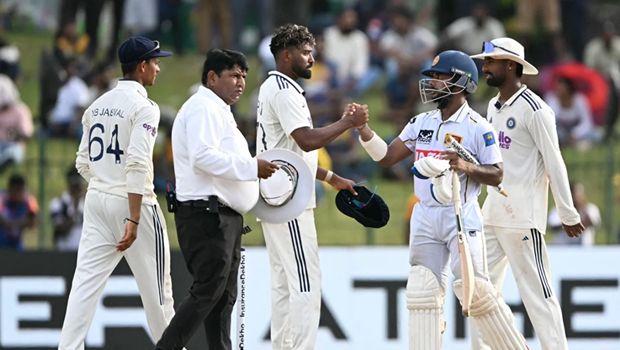
Well, I didn’t see this coming. I was certain India would bowl Sri Lanka out and win the second Test with ease on day five. Instead, a combination of an extraordinarily good batting surface and extraordinary stubbornness from the Sri Lankan lower order kept India on the field for more than two sessions, chasing the final four wickets.
India had done almost everything right. They declared on 503/9, bowled Sri Lanka out for 290 and enforced the follow-on, leaving the hosts 213 runs behind. Even when Sri Lanka reached 229/6 at the close on day four, with only four wickets remaining, the expectation was that India would finish the job on Thursday. But Sri Lanka simply refused to lose.
Keshara Nuwantha absorbed 150 balls for 46 before finally departing in the 105th over. India got the eighth wicket in the 117th, and for a moment it looked as though the door had finally opened. It hadn’t.
Lahiru Kumara faced 58 balls, while Sonal Dinusha produced perhaps the innings of the series, grinding his way to an unbeaten 133 from 264 deliveries. It was his second century of the match, his third of the series, and the knock that took defeat completely out of Sri Lanka’s equation.
Sri Lanka eventually finished on 429/9, and the match was drawn, leaving India with a 1-0 series victory but denying them the clean sweep they had looked certain to achieve.
Credit to Sri Lanka. And you simply cannot fault the Indian bowlers.

On a fifth-day pitch that remained excellent for batting, India’s bowlers tried everything. Manav Suthar was being put under serious pressure for the first time in his Test career. Saransh Jain endured a difficult debut. Even Ravindra Jadeja had to bowl 20 overs for just one wicket. Shubman Gill rotated his attack, but there was only so much the bowlers could extract from a surface offering very little assistance.
That’s Test cricket. Things don’t always come easily.
India still won the series, but this draw has made their World Test Championship equation more difficult. India remain fifth in the standings, and their margin for error over the remainder of the cycle has become extremely small.
I don’t think India did anything fundamentally wrong. Enforcing the follow-on was a perfectly understandable decision, particularly with the weather forecast and India’s control of the match. Sometimes, you simply have to give credit to the opposition. Sri Lanka were more determined on the final day, and it showed. India may have won the series, but Colombo belonged to Sri Lanka.