

























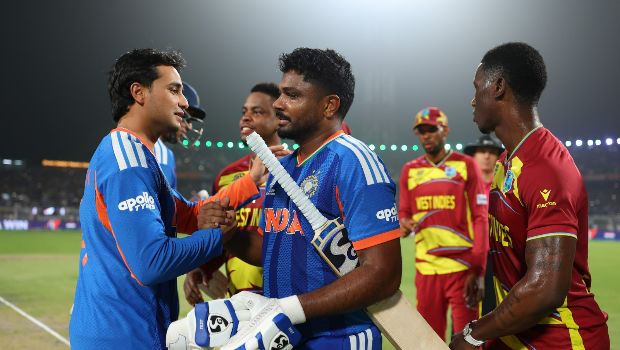
For a brief moment before the second T20I against England at Old Trafford, the television cameras drifted away from the action.
Sanju Samson had just made way in the XI for 15-year-old Vaibhav Sooryavanshi, whose debut was understandably the evening’s biggest talking point.
On the sidelines, head coach Gautam Gambhir walked over to Samson. The two shared a lengthy conversation. Gambhir spoke animatedly, repeatedly gesturing with his hands, while Samson listened quietly before nodding in response.
What was said remains unknown, but the exchange appeared more reassuring than disappointing. Samson was not a fringe player sacrificed for a tactical tweak. He was one of India’s senior T20I batters and a key contributor to the country’s T20 World Cup triumph earlier this year.
Those images carried greater weight when India’s squad for the five-match T20I series against Zimbabwe was announced on Monday.
Samson’s name was absent.
While the unofficial explanation was that he had been rested, sources told Sportstar the selectors wanted Sooryavanshi to get an extended run and saw little value in taking Samson to Zimbabwe if he was unlikely to play regularly. The idea instead was to keep him fresh for the Asian Games.
Whatever the reasoning, Samson became only the second member of India’s World Cup-winning T20 squad, after Suryakumar Yadav, to be left out.
His recent form offered the selectors an argument. He managed only six runs in three innings during the England series before losing his place. Even in the IPL, despite scoring 477 runs in 14 matches for Chennai Super Kings at an average of 43.36 and a strike rate of 165.63, his campaign lacked consistency.
Yet those numbers tell only part of the story.
Over the previous year, Samson had finally begun to justify the faith successive team managements had placed in him. Three successive half-centuries during the T20 World Cup helped India lift the title and earned him the Player of the Tournament award.

More importantly, his batting had evolved. The naturally gifted stroke-maker learnt to pace an innings, absorb pressure when required and still score at the tempo modern T20 cricket demands. He had transformed from an unpredictable aggressor into a dependable top-order batter.
For years, Samson’s international career was defined by unrealised potential and interrupted opportunities. It finally appeared that chapter had closed.
His omission therefore says as much about India’s selection philosophy as it does about his own form.
The emergence of Sooryavanshi, alongside Yashasvi Jaiswal, Abhishek Sharma, Tilak Varma, B. Sai Sudharsan, Ruturaj Gaikwad and Ishan Kishan, reflects the unprecedented depth available to India. Every dip in form is now accompanied by another compelling alternative.
There is obvious logic to that approach. India is already planning for the next T20 World Cup, and succession cannot be delayed.
But successful white-ball teams are rarely built on promise alone. They also trust proven performers to survive inevitable lean patches.
Samson’s recent failures strengthened the selectors’ case. His performances over the previous year make an equally persuasive argument for patience.
Whether this omission proves temporary or something more permanent will become clearer over the coming months. That conversation between Gambhir and Samson at Old Trafford may yet prove telling if the team management still sees him as part of India’s long-term plans.
India’s talent pool has never been stronger. The challenge for the selectors is no longer finding the next star, but ensuring the pursuit of tomorrow does not come at the expense of players who have already shown they can deliver when it matters most.