

























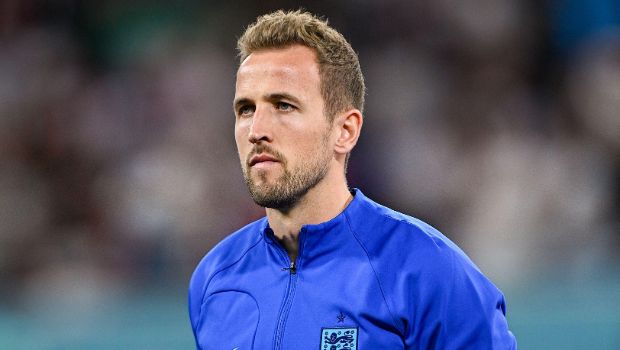
Harry Kane is actively pursuing Robert Lewandowski’s single-season Bundesliga goal record, having already scored 18 times this season.
The England captain believes he could surpass Lewandowski’s mark of 41 goals in a season, given his impressive start to the current campaign.
Lewandowski achieved 41 goals in just 29 appearances for Bayern Munich during the 2020-21 season, eclipsing Gerd Muller’s previous record of 40 goals from 1971-72.
Kane has netted 18 goals in 14 outings so far, helping Vincent Kompany’s Bayern team maintain a nine-point lead at the top after 12 wins and two draws.
In his record-breaking year, Lewandowski overperformed his expected goals (xG) of 32.3 by 8.7, while Kane has already exceeded his 11.9 xG by 6.1 this term.
On a per-90-minute basis, Lewandowski generated more xG in 2020-21 than Kane has in 2025-26 (1.18 compared to 0.99), along with more big chances (1.97 to 1.74) and shots (5.01 to 4.47).
However, the England captain has registered more shots on target per 90 minutes (2.57 versus 2.48).

Kane’s average of 1.49 goals per game is only slightly below Lewandowski’s 1.5, and if he remains injury-free, he feels confident about achieving a historic milestone.
Kane stated in an exclusive interview that breaking the single-season record is possible, particularly considering his strong start this year, though he acknowledged there is still a long way to go.
He emphasized the need to maintain this level for another four or five months, noting that consistency over a prolonged period is the hardest aspect in football.
Bayern is set to face Heidenheim in their final match of 2025 on Sunday, followed by a three-week winter break before hosting Wolfsburg.
The team has welcomed Jamal Musiala back to full training this week, five months after the creative midfielder suffered multiple ankle ligament ruptures at the Club World Cup. Kane believes Musiala is the most talented player in Bayern’s squad.
He is also pleased to see Alphonso Davies returning to contention for playing time after a nine-month absence due to a torn anterior cruciate ligament.